
When it comes to user interface and user experience in web designs, there is a fine line between interface and experience. For example, how a car looks like, the interior and luxury is the user interface and how it drives is the user experience. The user interface is directly linked with the user experience but the difference is significant and cannot be intermixed as one. One can always improve the interface while offering the best experience but can never sell a product on the interface alone – the user experience has to be unique for the users to invest time, money and effort in it.
Similarly, when it is about user experience and user interface in web designs, many products fail to perform or maintain the difference. A lot of times, a digital product looks great in aesthetics and visual appeal but sucks in usability and operations. Here’s what Peter Morville – the Interaction Architecture and President of Semantic Studios explains the facets of user experience. He further elaborates on how each facet should be addressed independently in a web design. With years of in-depth design study, he introduced a honeycomb design methodology based on seven different segments and explains how each segment contributes to developing a good user experience of a product. The significance of the user experience honeycomb lies in the background work of the product – how each segment must be explored while creating or designing a product.
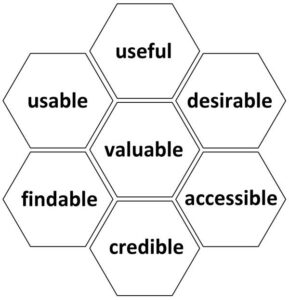
- Useful: Thoroughly look for the usefulness and need of the product. How useful and important the product would be in a user’s life? The more useful, the better it is going to be in offering the overall user experience.
- Usable: When devising the wireframes of a product, focus on the ease of usability. If it’s too complex for a newbie, work out ways to make it easy, simple and user friendly for all. According to ISO, “Usability is the extent to which a product can be used by specified users to achieve specified goals with effectiveness, efficiency, and satisfaction in a specified context of use.”
- Desirable: The desirability of a product is dependent on the emotional elements integrated into a product. If you know your audience, you can easily build upon the emotional triggers of the audience, however, it is not the only factor that plays in the background. To make it more desirable, a product needs to be close to emotional interactions.
- Findable: Nobody cares how good your product is if it’s not easily navigable or approachable. Make sure that the product once launched is easily locatable and assessable on all digital avenues.
- Accessible: Just like real-life buildings and architectures are designed to fulfill the need of differently-abled individuals, it is now ethically important to focus on making your digital product accessible to differently-abled individuals. Whether it needs you to incorporate audio commands or symbolic touch, it has to be easily accessible to every potential user. Peter Morville predicts that it is not far when accessibility is going to be included in the digital landscape laws, why not be the trendsetters and be the first ones to adapt to it.
- Credible: According to Peter Morville, there’s no alternative to credibility. If your product lacks credibility, there’s nothing you can do to grow your user base. No matter what you promise to your customers, make sure it is reflected in the product from start till finish. Your commitment to your customers should be the foremost priority of any product development design team.
- Valuable: The product must add value to all end-users. Whether it is just about the simplest act of providing the right information, the product must give something to the end-users by the time they exit the product. It can be as lean as customer satisfaction, but the value must be felt and enjoyed by the customers every time they use the product.
HOW TO BEST USE THE HONEYCOMB DESIGN DURING THE PRODUCT DESIGN?
The honeycomb design methodology by Peter Morville focuses on the background work of designing a product. It is why Peter Morville emphasizes using it in three significant ways during the ideation and creation stage of a product.
- Assess and re-assess the product needs, wants and user experiences around the products and their unique features. It is further advised to have meaningful conversations with multiple user-sets about improving and creating new experiences. Understand the product and see how it can impact people, how people will view the product, what features will immediately influence the attention etc.
- The product or the website should be tested not just once, twice or thrice but several times through different lenses to extract specific ideas about what to improve or build upon in a product. Always keep users at the forefront while designing a product, and it will help you evaluate the product in its truest form. It will also help you to get rid of unwanted features or excess screens to keep the user experience short, crisp and valuable.
- Always develop a product in stages to keep the users curious about new releases and extra features. If you lack time, budget and resources to launch a full-scale product, start with a single-facet makeover.
As the world is rapidly evolving with fierce competition throughout the globe, it is wise to carry out extensive researches on a digital product prior to any investment. Be it about time, money, efforts or intellect, it is better to dive into the product as deep as possible and understand the dynamics before any move. Once you are sure about designing a new digital product for a new market, make sure you are aware of the fine line between the user experience and the user interface. Or, you have hired a qualified custom web design company to look after the key areas of your product. Also, it is critical to understand that user experience is gauged with return on investments, conversions, subscriptions and paid customers, it is not just about the number of downloads, reviews and social media hustle. Because at the end of the day, a sustainable product is a lot more about the revenue stream and market scalability – the rest is just books!